External venetians — the ridge’s hardest-working shade
Aluminium venetians mounted outside the glass, not inside it — the most effective solar control there is, because the heat is intercepted before it ever enters the building.
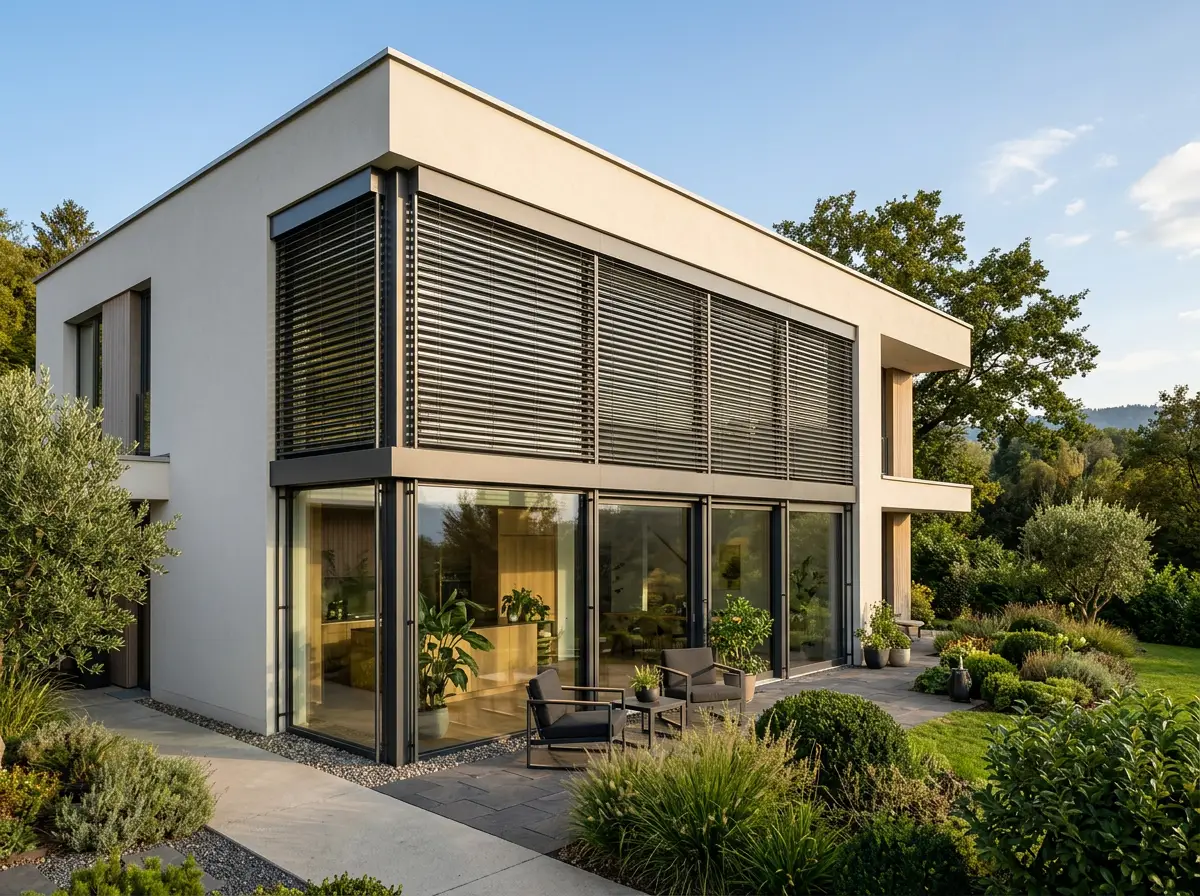
Interior blinds manage heat that’s already inside the room. Exterior shading stops most of it at the glass, before it ever becomes the aircon’s problem. On a big north- or west-facing elevation, the difference in how the room actually feels is dramatic — it’s how architects shade glass buildings properly, brought down to house scale.
What it actually is
Wide aluminium slats, typically in the 60–90mm class, running in guided side rails or cables that tilt and raise. Finishes are powder-coated and engineered for weather exposure, so the facade reads as architecture, not as an add-on.
Built for the exposure up here
Ridge positions catch more wind than the valley floor, so external venetians are effectively always motorised, with a wind sensor set to auto-retract before a gust or a Pretoria afternoon thunderstorm arrives. That auto-retract is doing real protective work, not just convenience.
Where it makes the biggest difference
Ridge and view homes with hard west or north exposure are exactly the case external venetians were built for — big unbroken glass that a homeowner already knows “the aircon can’t keep up with.” Architect renovations and estate homes wanting clean, aesthetics-committee-friendly lines are the other common brief.
Honest limitations
It’s a premium spend, positioned as a building improvement rather than window dressing, and it changes the facade’s appearance — estates with an aesthetics committee may want a submission before installation. It isn’t a DIY product, and design-stage planning gives the cleanest result, though retrofit is possible on suitable elevations.
The cost of stopping sun outside the glass
This is engineered aluminium fixed to the outside of the building and built to stand in wind, so the number sits well above anything interior: R3,000 to R4,500 per square metre installed hand-operated, and R4,500 to R6,500 motorised. On a ridge-facing elevation almost every set goes in motorised, because a sensor that lifts the slats ahead of a highveld storm is the reason the product survives its seasons.
Slat width, the guide channels and what sits behind the render all move a job inside that band, and a narrow opening carries a minimum charge. Nothing exterior is quoted off a photograph: the facade, the substrate and the exposure are all read at the free measure, and the written price follows that.
Let’s look at your elevation.
Free in-home measure, an honest read on whether external venetians suit your facade, and a written quote either way.