Roller blinds, specified for Faerie Glen’s light
One fabric, one tube, no fuss. The roller blind is the quiet default of this suburb for a reason — but on a ridge that stares west into the Pretoria afternoon, which fabric goes on that tube matters more than most fitters admit.
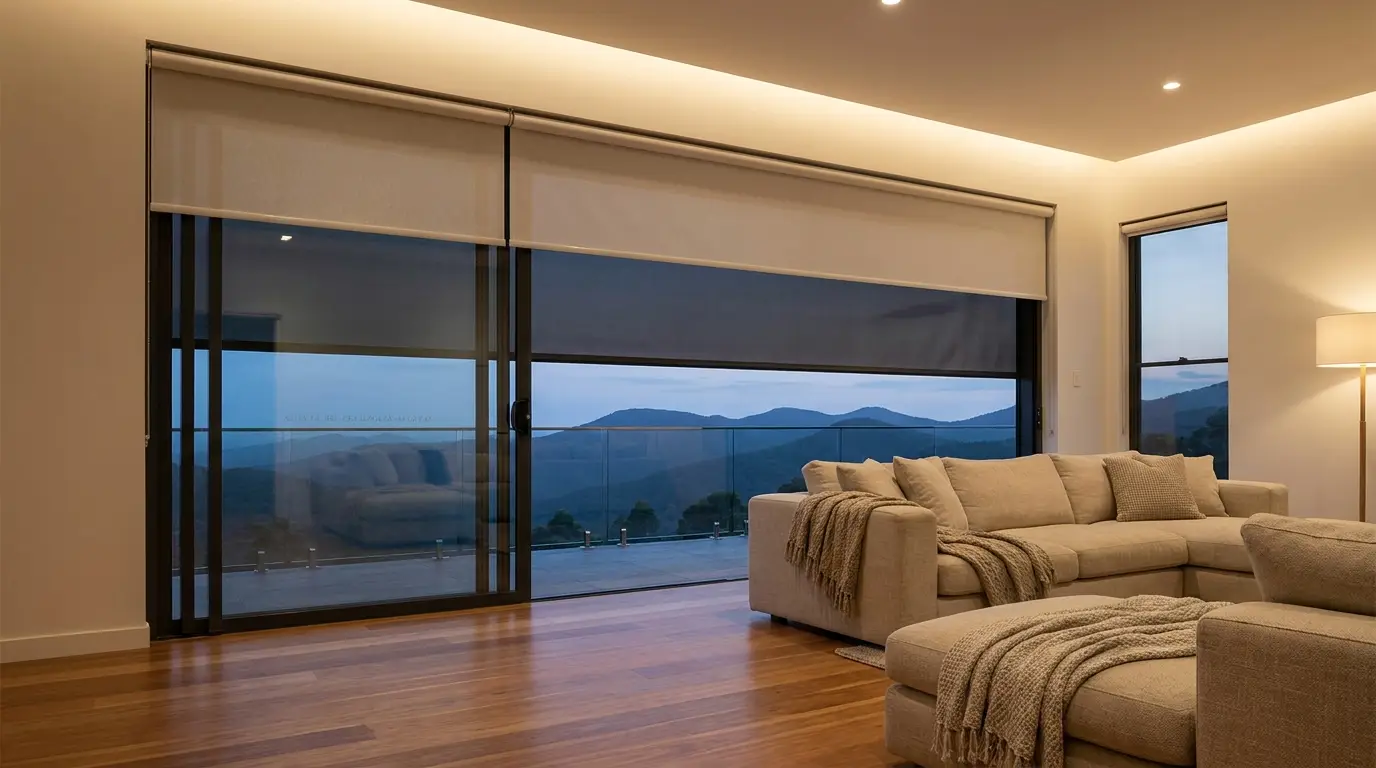
Walk through most homes off Glenwood Road or up toward the Bronberg side of the suburb and you’ll find rollers on more windows than every other blind combined. Fair enough. They clean with a damp cloth, they disappear when raised, and a made-to-measure drop sits flush in the reveal instead of flapping in front of it.
But a roller is only ever as clever as its fabric. So start there.
Match the fabric to what the room fights
Faerie Glen’s houses tend to put their biggest glass where the view is — and on this ridge the view and the western sun arrive through the same pane. Each room is fighting something slightly different:
- The view lounge fights glare. A sunscreen mesh at 3–5% openness knocks down the shimmer and the UV while the valley stays visible through the weave. One honest caveat we repeat at every measure: after dark, with lamps on inside, that see-through effect flips — the street sees in. Plan for that if the room faces a neighbour.
- Bedrooms fight the early highveld sunrise. Blockout coating on the back of the fabric, fitted deep in the reveal to shrink the light gap at the edges, is the difference between a 5am summer wake-up and an actual lie-in.
- Kitchens and bathrooms fight steam and splashes. A wipeable, moisture-happy weave on an aluminium tube shrugs this off — no warping, no water marks, which is why rollers beat fabric-heavy alternatives in wet rooms.
- Living areas without the view mostly want softness. A translucent fabric glows rather than glares, gives full daytime privacy, and skips the bunker feel of blockout.
Two tubes, one bracket: the ridge bedroom answer
Plenty of Faerie Glen main bedrooms face the view. Lovely at 7am, complicated at 9pm. The double roller solves it without choosing: a sunscreen and a blockout run on the same bracket set, so you pull down the mesh for the daytime valley and drop the blockout when you actually want to sleep. Two blinds, one clean cassette, no argument between them.
Sizes, chains and the details we check on site
A single roller runs happily to about three metres of width. Past that the tube deflects, so a wide slider gets either a matched linked pair or a motor — usually a motor, because at that size a chain is hard work anyway. Speaking of chains: every chained roller we fit gets a wall-mounted tensioner as standard, and for nurseries we’ll steer you to motorised or spring-assist so there’s no loop at all. On the day of the measure the consultant also checks reveal depth (burglar bars and window handles love to snag a new blind), which way the room faces, and whether a cassette pelmet colour-matched to your frames is worth the small extra.
Quick answers
Can one roller cover my 3.5 m stacking door?
Not as a single blind — fabric that wide sags and the tube bows. We’d fit a linked pair on one line, or two motorised blinds that move together at the press of one button. The join line lands where a door mullion already breaks the glass, so it reads as intentional.
Which sunscreen openness keeps the ridge view best?
For west- and north-facing Faerie Glen glass we quote 3% or 5% openness almost every time. 3% wins on glare control for a proper west-facing wall of glass; 5% shows a touch more of the valley on softer aspects. The consultant brings both weaves to hold against your actual window — the fabric looks different against your light than in any photo.
Do rollers survive a steamy bathroom?
Yes, if specified for it — a PVC-coated or polyester weave on an aluminium tube doesn’t mind condensation, and there’s no fabric fold for damp to sit in. We’d avoid linen-look weaves in a bathroom; they mark. Say which room each blind is for on the enquiry and the quote will reflect the right fabric family.
The roller band, before we measure
These are guide figures per square metre, installed. A hand-operated roller — chain or spring, in blockout, sunscreen or a light-filtering weave — comes out at R1,000 to R1,600 per square metre, with an entry blockout at the bottom and a premium mesh, a cassette or a twin-fabric bracket at the top. Motorised, the same window works out at R2,500 to R3,800 per square metre.
There is a minimum charge on small windows, since a narrow blind still needs its tube, its brackets and its turn on the ladder. And a band is not a quote: every opening is priced individually after the free measure and confirmed in writing before it goes into production.
Let’s measure your windows properly.
The measure at the house is free, the quote is written and priced window by window — and if roller isn’t the right fit for your rooms, we’ll say so.